












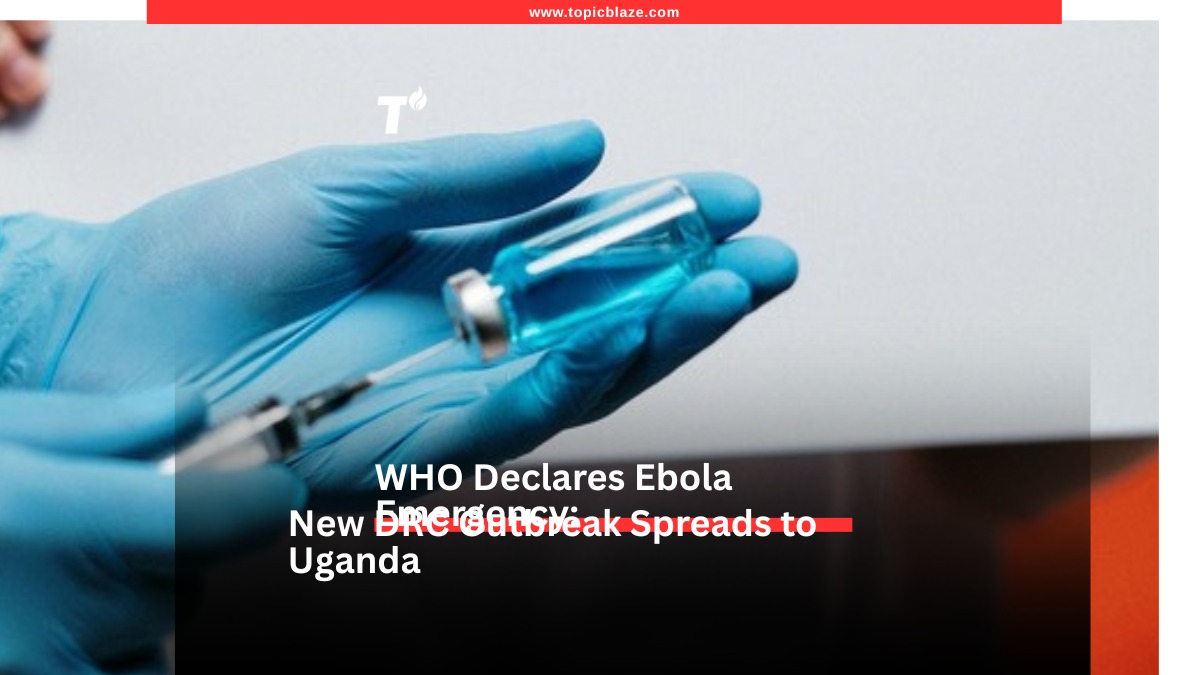
The World Health Organization declared a Public Health Emergency of International Concern (PHEIC) on Saturday, May 17, 2026 — its highest level of global health alert — after a new Ebola outbreak in the Democratic Republic of Congo and Uganda killed 88 people and infected at least 336. The outbreak involves the Bundibugyo strain of the Ebola virus, a rare variant for which there is currently no approved vaccine and no approved treatment. It is spreading across one of the most conflict-affected, infrastructure-poor regions on earth, and it has already reached two capital cities.
What Is the Bundibugyo Strain — and Why Is It So Dangerous?
The Ebola virus family includes six known species. The most lethal and the most studied is Zaire ebolavirus, which caused the devastating 2014–2016 West Africa outbreak that killed more than 11,000 people. An approved vaccine — rVSV-ZEBOV, marketed as Ervebo — now exists for the Zaire strain. The Bundibugyo species is different. It was first identified in 2007 in Uganda’s Bundibugyo district, resurfaced in the DRC’s Isiro district in 2012, and has now appeared for the third time ever in Ituri Province, DRC — a remote, conflict-ridden mining region in the country’s northeast.
The case fatality rate for Bundibugyo Ebola historically ranges between 25% and 36%, lower than the Zaire strain’s 50–90% rate in untreated patients, but still catastrophically high. More importantly, there is no approved vaccine or treatment. The experimental antibodies and antiviral drugs that proved effective against Zaire Ebola — mAb114 and Remdesivir — have not been validated against Bundibugyo. WHO and partner organisations are rushing to deploy experimental countermeasures under emergency use protocols, but the cupboard is nearly bare.
“This is the worst possible strain to see emerge in the worst possible place at the worst possible time. No vaccine, no treatment, active armed conflict preventing health workers from accessing communities, and population movement that has already seeded cases in two capitals. The global health community needs to mobilise immediately and at scale.”
— Dr. Tedros Adhanom Ghebreyesus, Director-General, World Health Organization
The outbreak originated in Mongwalu, a busy gold-mining hub in Ituri Province, where migrant workers from across eastern DRC and Uganda congregate. The index case — the first confirmed patient — fell ill in late April. By the time the outbreak was confirmed by laboratory testing, at least 40 secondary cases had already occurred. Infected individuals subsequently travelled by bus, motorcycle taxi, and small aircraft to other provinces, including cases reaching Kinshasa, the DRC capital with a population of 17 million.
How Far Has the Outbreak Spread — and What Is Being Done?
As of Saturday’s WHO declaration, confirmed and suspected cases have been recorded in four DRC provinces: Ituri (the epicentre), North Kivu, South Kivu, and Kinshasa. Uganda has confirmed two laboratory-verified cases, both linked to travellers from Ituri — one of whom died in Kampala, Uganda’s capital. The Africa CDC, which coordinates continent-wide health emergency responses, has assessed the risk to neighbouring countries — including Rwanda, Burundi, Tanzania, and South Sudan — as “high,” citing porous borders, active population movement, and inadequate surveillance infrastructure.
The WHO’s PHEIC declaration triggers several immediate consequences: it activates the International Health Regulations framework, requiring all 196 signatory nations to step up surveillance and share real-time data; it unlocks emergency financing from the WHO Contingency Fund for Emergencies; and it sends a formal signal to governments and donors that resources are urgently needed. The US Centers for Disease Control and Prevention has deployed an Emergency Response Team of 22 epidemiologists and public health specialists to Bunia, Ituri’s provincial capital. The CDC has also issued a Level 2 Travel Alert — “Practice Enhanced Precautions” — for DRC and Uganda.
The containment challenge is severe. Armed militia groups operating in Ituri Province have attacked health workers during previous outbreak responses, including during the 2018–2020 Zaire Ebola outbreak that killed 2,287 people in the same region. WHO has already reported two incidents in which response teams were prevented from accessing affected communities by armed actors. Without the ability to safely conduct contact tracing and ring vaccination — the core tools of Ebola containment — the outbreak risk profile rises sharply. Scientists at Imperial College London estimate that without effective containment, the outbreak could infect between 2,000 and 8,000 people over the next 90 days.

What This Means For You
For Americans, the immediate risk is very low. Ebola does not spread through the air; transmission requires direct contact with the bodily fluids of a symptomatic patient. The CDC’s travel alert does not recommend avoiding DRC or Uganda — only enhanced precautions for those who must travel there. The bigger concern is systemic: a PHEIC on top of an already-strained global health architecture — still recovering from COVID-19, monkeypox, and Sudan ebolavirus outbreaks — tests the world’s capacity to respond simultaneously to multiple emergencies. The US contributes roughly 18% of WHO’s core budget; American engagement and resourcing will be pivotal to whether this outbreak is contained in weeks or allowed to become a months-long catastrophe. If you have travelled to DRC or Uganda recently and develop fever, muscle aches, or unexplained bleeding, seek medical care immediately and inform healthcare providers of your travel history.
Sources
- WHO — Ebola outbreak in DRC and Uganda declared PHEIC
- CNN — New Ebola outbreak in Congo kills 80
- NPR — WHO declares Ebola outbreak a global health emergency