










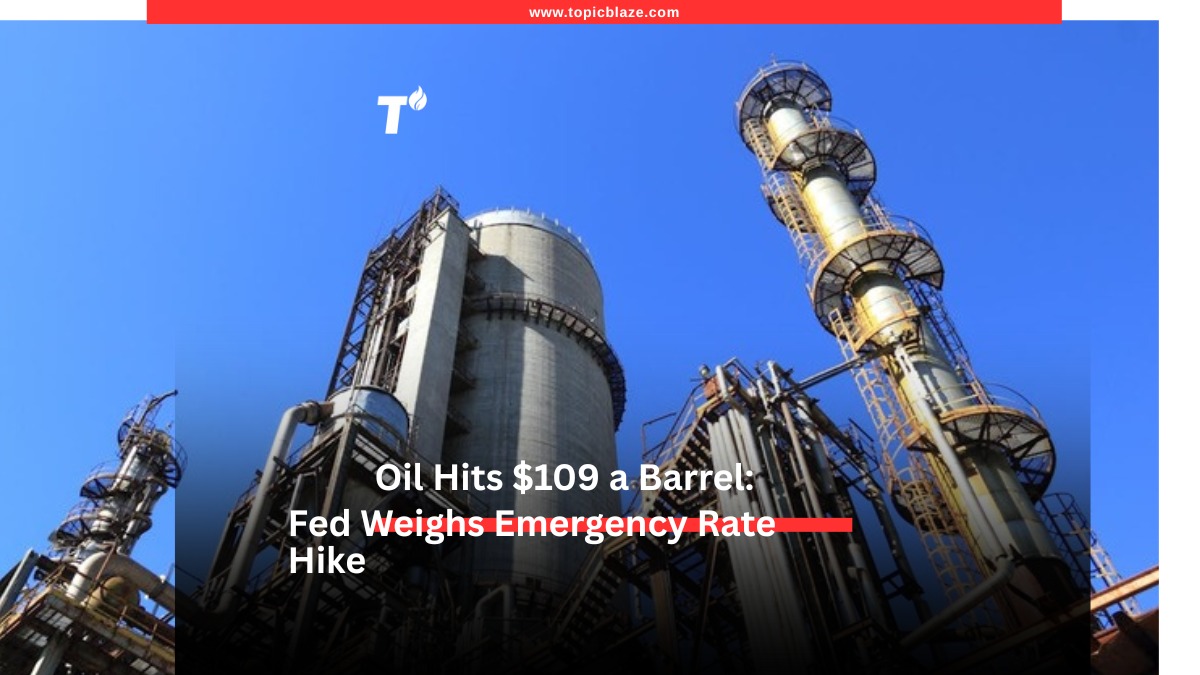
Brent crude hit $109 a barrel this week for the first time since 2022. The Dow Jones Industrial Average shed more than 400 points. The 10-year Treasury yield spiked to 4.55% — a one-year high. And for the first time in this economic cycle, markets are now pricing a 45% probability that the Federal Reserve will raise interest rates before the end of 2026. One month ago that probability was 1%. What changed? The Iran war, a stubbornly hot economy, and a Federal Reserve that is rapidly running out of room to manoeuvre.
Why Did Oil Hit $109 — and Why Does It Matter?
The proximate cause is geopolitical: ongoing US military operations in the Strait of Hormuz, through which roughly 20% of the world’s oil supply passes daily, have disrupted tanker shipping and sent insurers scrambling to reprice war-risk premiums. Brent crude, the global benchmark, jumped from $94 to $109 in less than three weeks. Gasoline at the pump has followed: the national average is now $4.46 per gallon, with California exceeding $5.80.
The knock-on effect through the broader economy is substantial. Higher energy costs feed directly into the Producer Price Index — PPI rose 1.4% in April alone, far ahead of the 0.5% economists had expected. That surge in producer costs is already showing up in manufacturing and transportation. FedEx and UPS both issued earnings guidance revisions citing higher fuel surcharges, while American Airlines warned investors of a 12% increase in operating costs in the current quarter.
“We are in uncharted territory. A Fed that was on hold is now staring at an oil shock it did not cause and cannot cure with interest rate policy. Raising rates to fight energy-driven inflation risks tipping the economy into recession. Not raising rates risks inflation expectations becoming unanchored. Neither option is good.”
— Michael Feroli, Chief US Economist, JPMorgan Chase
The Federal Reserve’s own May inflation forecast, updated this week, projects CPI hitting 4.2% year-over-year — the highest reading since April 2023. That compares to the Fed’s 2% target and is sharply above the 2.9% recorded at the end of 2025. The Cleveland Fed’s “inflation nowcast” — a real-time model — shows the acceleration is driven almost entirely by energy and transportation, not by underlying consumer demand. That distinction matters enormously for policy: rate hikes can cool demand, but they cannot drill more oil.
Is the Federal Reserve About to Raise Interest Rates?
The CME FedWatch Tool — the market’s real-time gauge of Fed rate expectations — shows a 45% probability of at least one rate hike by December 2026. That is a dramatic shift from the dominant narrative of just 60 days ago, when the conversation was entirely about when the Fed would begin cutting. The S&P 500 trades at 21 times forward earnings, a premium to its five-year average of 19.9x — meaning even a modest rate hike could trigger a significant repricing of risk assets.
Fed Chair Jerome Powell has so far refused to signal a hike. Speaking after the FOMC’s May meeting, Powell called the current inflation spike “supply-side in nature” and said the Fed would “need to see evidence of sustained, broad-based price pressure before adjusting the policy rate upward.” But markets are not waiting for the Fed to blink. The 30-year Treasury yield briefly touched 5.03% on Friday — a level not seen since 2007 — reflecting investor concern that the US government’s fiscal position is deteriorating faster than the central bank can contain.
The S&P 500 finished the week down 2.1%, its worst weekly performance since February. Tech stocks led the decline — the Nasdaq fell 3.4% — as rising long-term yields erode the present value of future earnings. For investors in growth stocks, the coming weeks may be among the most turbulent of the decade. For the broader economy, the key question is whether the oil shock proves temporary (as military tensions ease) or structural (if the Hormuz disruption becomes permanent). See our detailed analysis of how the Iran war is already hitting gas prices for everyday Americans.
What This Means For You
If you have a variable-rate mortgage, HELOC, or carry credit card debt, a Fed rate hike would push your interest payments higher. If you own equities, brace for continued volatility — markets will gyrate with every Fed speech and CPI print between now and December. If you are a saver with money in high-yield savings accounts or CDs, a rate hike is good news: yields could push above 5% for the first time since 2007. For drivers, there is little relief in sight until the Hormuz situation stabilises. The most prudent move right now: reduce floating-rate debt exposure, hold more cash than usual, and resist the urge to buy the dip until there is clearer evidence that the oil shock is peaking.
Sources
- TheStreet — Stock Market Today May 15: High Yields and Inflation Fears
- Yahoo Finance — Federal Reserve’s May Inflation Forecast
- CNBC — Stock Market News May 15, 2026