










Peace talks between the United States and Iran have hit a wall. On April 29, 2026, President Trump rejected Iran’s latest proposal — which offered to reopen the Strait of Hormuz and end the naval blockade in exchange for a ceasefire and delayed nuclear negotiations — saying it did not provide sufficient guarantees on Iran’s nuclear programme. The deadlock has sent oil prices higher and raised fresh fears about the long-term viability of a diplomatic resolution to the most consequential geopolitical conflict of 2026.
What Was Iran’s Hormuz Proposal — And Why Did Trump Say No?
Delivered to US envoys via Pakistani mediators in late April, Iran’s proposal had two parts: Tehran would agree to reopen the Strait of Hormuz — through which roughly 20% of the world’s oil supply flows — if the US lifted its naval blockade on Iranian ports. Nuclear negotiations, under this framework, would only begin after a ceasefire and the blockade’s removal were fully established. It was, in essence, a “Hormuz first, nukes later” offer.
From Iran’s perspective, the logic is straightforward: they want to relieve the economic strangulation of the blockade before conceding anything on nuclear enrichment. From Washington’s perspective, this is a non-starter. Allowing Iran to reopen the strait and secure an economic lifeline before nuclear guarantees are locked in would strip the US of its primary source of negotiating leverage. Trump told Axios on April 29: “They can’t have a nuclear weapon. I don’t love this proposal.” He subsequently confirmed he had rejected the offer outright, with a warning that Iran should “get smart soon.”
“Iran’s Hormuz proposal is tactically clever but strategically unacceptable for Washington. It asks the US to surrender its best leverage — the blockade — before getting anything concrete on the nuclear file. No administration, Republican or Democrat, would accept that sequencing.”
— Richard Nephew, Adjunct Senior Research Scholar, Columbia University School of International and Public Affairs
Iran, for its part, has refused Trump’s central demand: a full cessation of uranium enrichment and a formal renunciation of nuclear weapons. Tehran argues that enrichment is a sovereign right under the Nuclear Non-Proliferation Treaty, and that any agreement must leave civilian nuclear infrastructure intact. The two positions appear, for now, irreconcilable.
What Does the Deadlock Mean for Oil Prices and Global Trade?
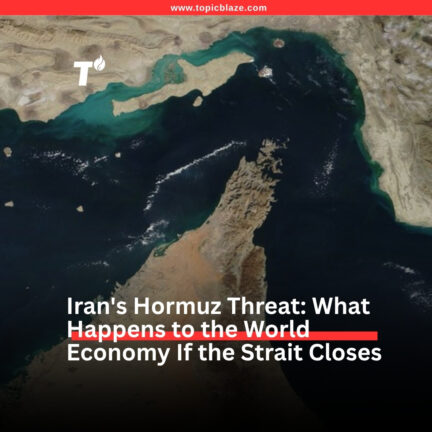
The Strait of Hormuz connects the Persian Gulf to the Gulf of Oman and the wider Indian Ocean — it is the single most critical oil chokepoint on Earth. As TopicBlaze has previously reported, Iran’s ability to threaten or close the Strait gives it enormous economic leverage. Since the war began, tanker traffic through the strait has been disrupted by Iranian naval operations, pushing insurance premiums for Persian Gulf shipments to historic highs.
With the diplomatic deadlock now official, energy markets are pricing in an extended standoff. As we covered in depth earlier this month, oil prices had been falling on expectations of a deal — those expectations are now unwinding rapidly. If negotiations remain frozen through summer 2026, analysts at Goldman Sachs and Citigroup are warning of a renewed spike toward $95–$100 per barrel, with knock-on effects for airline fuel costs, shipping, and consumer inflation worldwide.
| Issue | US Position | Iran Position |
|---|---|---|
| Strait of Hormuz | Open only after nuclear deal | Open first, nuclear talks later |
| Nuclear enrichment | Full cessation required | Civilian programme non-negotiable |
| Naval blockade | Continues as primary leverage | Must be lifted before talks proceed |
| Ceasefire | Conditional on nuclear limits | Unconditional ceasefire first |
Earlier peace talks in Islamabad reflected the same structural impasse. As we covered in depth, Trump pulled out of the Islamabad negotiations citing Iran’s refusal to make binding nuclear commitments upfront. The Hormuz proposal is, in essence, a repackaged version of the same Iranian offer that collapsed those talks — suggesting neither side has significantly moved its red lines.
What This Means For You
For American consumers, a prolonged Iran nuclear deadlock means sustained pressure on gasoline prices, air travel costs, and the broader inflation picture that the Fed has been working to bring under control. For global businesses dependent on Persian Gulf supply chains, the uncertainty is already disrupting forward planning. And for the wider world, the failure to bridge the Hormuz gap means the military conflict between the US, Israel, and Iran remains in a volatile pause — not a genuine ceasefire — with all the risks that entails. Watch the oil price: it is the clearest real-time signal of whether diplomacy is making any progress.
Sources
- Axios — Trump rejects Iran’s offer, says blockade stays until nuclear deal
- Al Jazeera — What’s in Iran’s latest proposal and how has the US responded?
- NPR — Deadlock over Iran’s nuclear programme and the Strait of Hormuz cripples peace efforts




[…] Iran Nuclear Deadlock 2026: Why Trump Rejected the Strait of Hormuz… […]
[…] Iran Nuclear Deadlock 2026: Why Trump Rejected the Strait of Hormuz… […]