















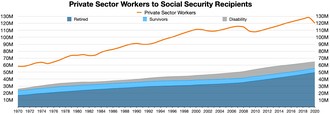
The latest Social Security Trustees Report contains a number that Washington has been slow to reckon with publicly: the program’s combined trust funds are now projected to be depleted by 2033 — one year earlier than last year’s estimate. At that point, without congressional action, benefits would be automatically cut by approximately 21 percent for all 70 million Americans who receive them.
The revision reflects several converging pressures: slower-than-projected wage growth, demographic shifts as Baby Boomers continue to age into the system, and longer-than-expected lifespans among current beneficiaries. The program’s finances are not in freefall — Social Security still collects trillions in payroll taxes each year — but the gap between what it collects and what it pays out is widening faster than actuaries had anticipated.
For most Americans, the abstract conversation about trust funds becomes concrete quickly. A 21 percent automatic cut would reduce the average retired worker’s monthly benefit by roughly $340. For the one in four Americans over 65 who rely on Social Security for at least 90 percent of their income, that reduction would be catastrophic.
Doing nothing is itself a choice — and it’s a choice that results in an automatic benefit cut that no Congress has ever officially voted for, but that will happen unless someone acts.
— Kathleen Romig, Center on Budget and Policy Priorities
The political challenge is well-known and stubborn. Meaningful fixes require either raising payroll taxes, raising the retirement age, means-testing benefits, or some combination — all of which are politically toxic in different directions. Republicans have historically resisted tax increases; Democrats have resisted benefit cuts. The result is legislative paralysis despite a ticking clock that all parties can read.
Several bipartisan proposals are circulating in the Senate, including a bill that would gradually raise the payroll tax cap and increase the full retirement age for younger workers while protecting current and near-retirees. But none have the votes. The 2026 midterm cycle makes any major reform politically harder, as neither party wants to hand the other a campaign issue.
The math does not care about election calendars. Every year Congress delays costs more — either in larger tax increases, steeper benefit reductions, or both.
The clock is now seven years away from striking midnight, and Washington’s silence on the issue is becoming harder to justify.