












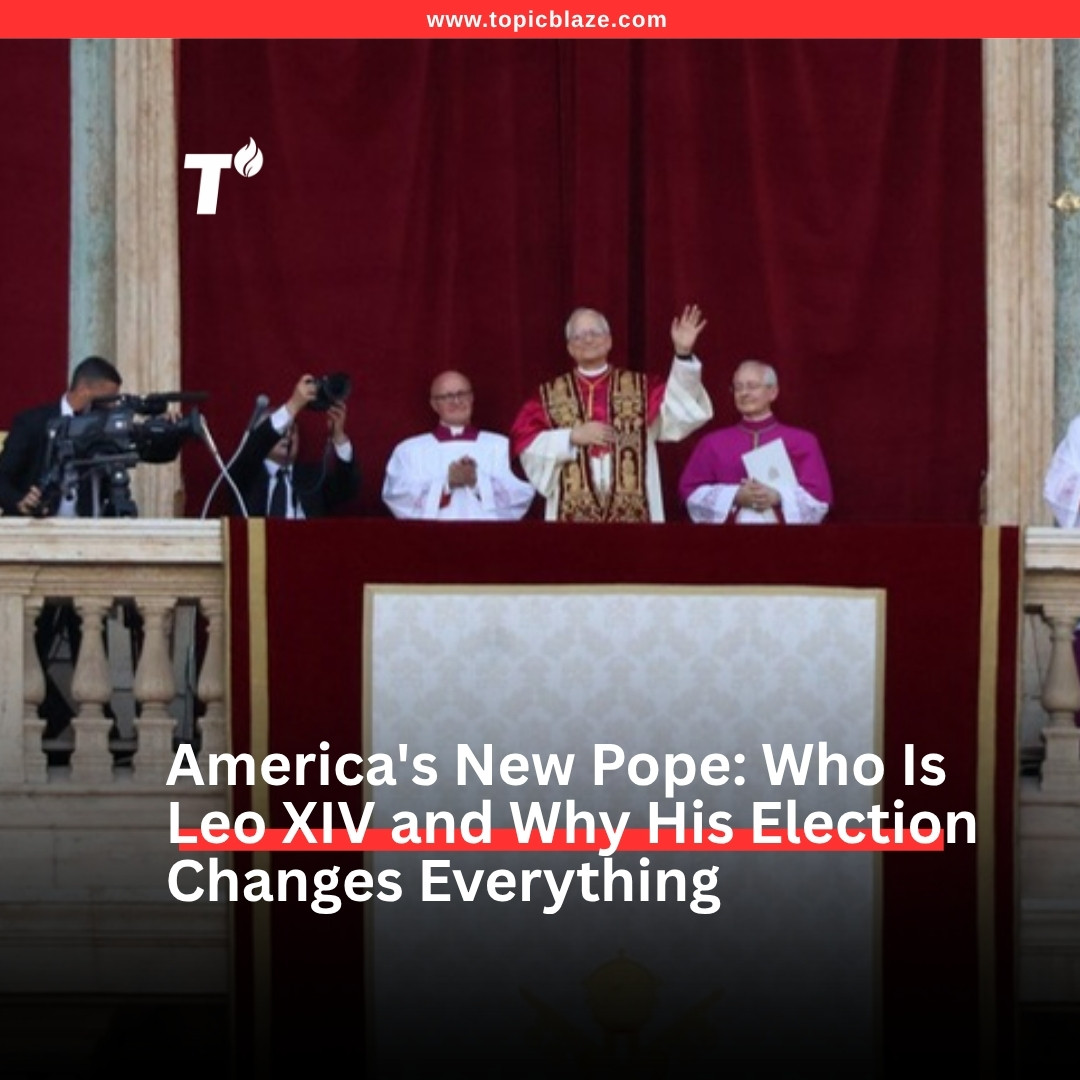
For the first time in the two-thousand-year history of the Catholic Church, an American now sits on the throne of Saint Peter. Robert Francis Prevost — a native of Chicago — emerged from the Sistine Chapel as Pope Leo XIV following a conclave that lasted several days and produced one of the most unexpected outcomes in modern Vatican history. The world watched as white smoke rose above St. Peter’s Square, and the announcement sent shockwaves far beyond the boundaries of the Catholic faith.
Prevost, 69, is an Augustinian friar who spent decades doing missionary work in Peru before rising to become a Cardinal and, most recently, the Prefect of the Dicastery for Bishops — a critically influential position that gave him oversight of bishop appointments worldwide. His deep familiarity with both the Global South and the institutional machinery of Rome made him a candidate uniquely positioned to bridge divides within an increasingly fractured Church.
He chose the name Leo — the name of great reform popes and social justice advocates. That choice alone is a statement of intent.
— Vatican analyst Thomas Reese, writing in Religion News Service
The choice of Leo XIV as his papal name carries significant weight. Pope Leo XIII, who served from 1878 to 1903, is remembered for the encyclical Rerum Novarum, which laid the foundations for modern Catholic social teaching on labor rights and economic justice. Prevost’s decision to invoke that legacy suggests a pontificate likely to focus on inequality, migration, and the environment — themes that have already defined his early statements.
Leo XIV’s election also reflects a broader shift in the gravitational center of global Catholicism. With more than 1.3 billion Catholics worldwide, the largest concentrations are now in Latin America, sub-Saharan Africa, and Asia. The selection of an American pope with deep ties to the Global South represents something of a compromise candidate — someone whose biography spans both worlds in a way no purely European choice could.
Within hours of his election, Leo XIV appeared on the balcony of St. Peter’s Basilica and delivered his first address in both Italian and Spanish, notably skipping English entirely. That choice was widely interpreted as a signal that his pontificate would prioritize the Church’s global majority over its traditional European and American centers of power.
Whether Leo XIV will prove to be the reformist many progressives are hoping for — or the doctrinal stabilizer conservatives are counting on — remains to be seen.
What is clear is that the Catholic Church, for the first time in its history, will be led by a man who grew up attending Mass in America, watching the Cubs lose, and navigating the particular contradictions of being Catholic in the world’s most powerful secular democracy. That alone makes this papacy unlike any that came before it.