












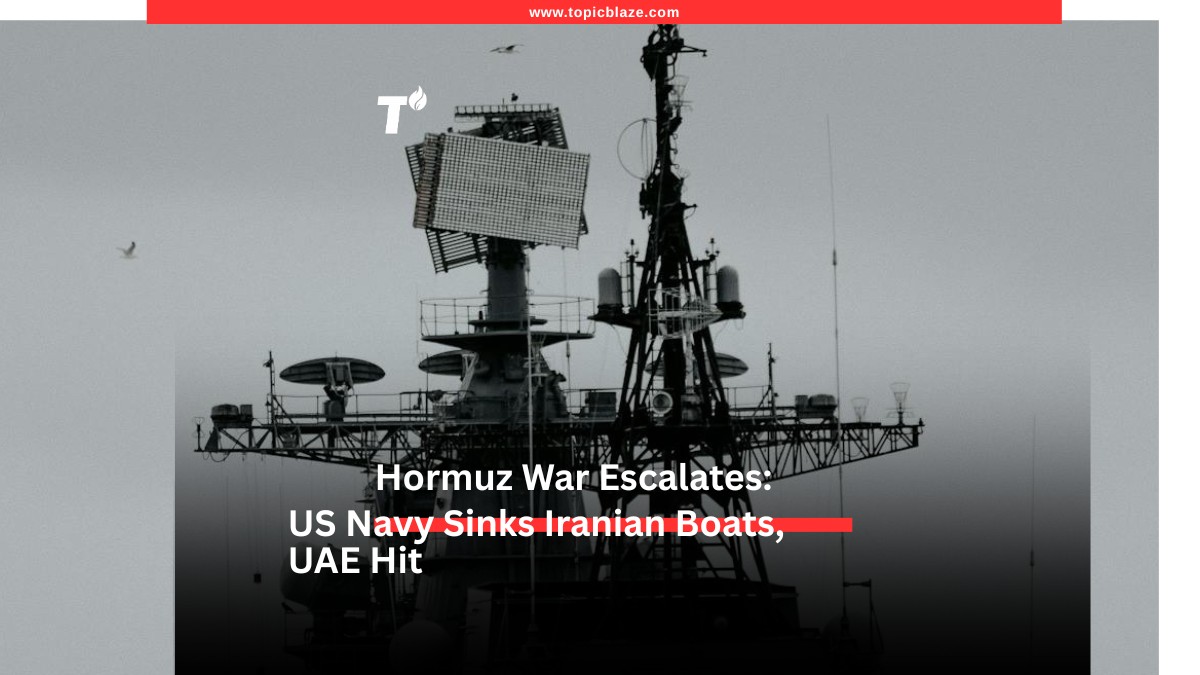
The Strait of Hormuz turned into an active combat zone on Monday as the United States Navy sank seven small Iranian vessels after Iran launched cruise missiles, drones, and small boats against American warships and commercial shipping in the world’s most critical oil chokepoint. The escalation — which came hours after President Trump launched “Project Freedom” to reopen the waterway — marks the deadliest day of direct US-Iranian naval combat in the ongoing 2026 conflict, with the United Arab Emirates reporting it intercepted 19 Iranian missiles and drones targeting its territory.
What Happened in the Strait of Hormuz on May 4?
US Central Command confirmed Monday that American forces “sank seven Iranian fast-attack craft” after they attacked Navy ships and commercial vessels attempting to transit the strait. Iran’s Islamic Revolutionary Guard Corps (IRGC) launched the assault using what the Pentagon described as a combination of cruise missiles, armed drones, and swarm-style small boat tactics — a pattern Iranian forces have rehearsed for decades in the event of confrontation with a superior naval force.
Iran’s state broadcaster claimed two of its missiles struck a US Navy frigate in the strait, a claim the Pentagon flatly denied. “No US vessel was struck,” CENTCOM said in a statement. “The safety of our forces and freedom of navigation in international waters remains our top priority.” The IRGC issued a warning that any foreign military force approaching or entering the strait would be “targeted,” directly challenging the premise of Project Freedom.
“This is the most significant direct exchange between US and Iranian naval forces since the 1988 Operation Praying Mantis. The IRGC is testing exactly how far the US is willing to go, and the answer from Washington so far has been: pretty far.”
— Lt. Gen. (ret.) James Winnefeld, former Vice Chairman of the Joint Chiefs of Staff
Despite the violence, Adm. Brad Cooper, commander of US Central Command, told reporters that American forces had successfully cleared a mine-free passage through the strait and escorted the first convoy of commercial vessels through the waterway. More than 100 ships have been stranded for weeks since Iran effectively blockaded the strait in March, and Monday’s operation marked the first deliberate attempt to break that blockade by force.
Why Did the UAE Come Under Iranian Missile Attack?
The UAE’s entry into the conflict is a major escalation. Abu Dhabi confirmed that its Patriot air defense batteries “engaged 12 ballistic missiles, 3 cruise missiles, and 4 UAVs launched from Iran,” resulting in three moderate injuries on its territory. Iran has long viewed the UAE as a US proxy in the Gulf and as a key transit point for oil shipments that Tehran wants to control. The attack on UAE soil risks drawing a broader coalition into the conflict, with Saudi Arabia and other Gulf states watching closely.
Iran’s IRGC also unveiled a new operational map of the Strait of Hormuz marking zones it claims as exclusively under Iranian military control — a direct challenge to the UN Convention on the Law of the Sea, which guarantees freedom of navigation in international straits. Oil markets reacted sharply; Brent crude surged past $120 per barrel before settling around $119 by late afternoon, and gas prices nationally hit a new high of $4.46 per gallon according to AAA.
Is This the Start of a Wider Regional War?
Regional analysts are watching three flashpoints carefully: whether Iran will target Saudi oil infrastructure (something Tehran has threatened but not yet executed), whether the IRGC will attempt to completely mine the strait’s navigable channels, and whether Iran’s proxy forces in Iraq and Yemen will escalate simultaneous attacks on US military bases. US carrier strike groups are currently positioned in the Arabian Sea and the Red Sea, giving commanders significant options for a broader response.
The situation is sharply different from earlier rounds of US-Iran tension because this time both sides have already traded live fire repeatedly. TopicBlaze previously reported on Trump’s Project Freedom naval escort operation and the earlier Iran nuclear deadlock that preceded the current military phase.
What This Means For You
For American drivers and consumers, the Hormuz escalation has immediate consequences: gas prices have now hit $4.46 per gallon nationally, up 49% since the war began in late February, and analysts warn $5-per-gallon fuel is possible if the strait remains contested. Inflation data already reflects the energy shock, with the Consumer Price Index running at 3.3% annually. If this conflict broadens to include direct US strikes on Iranian territory, markets could react even more sharply — which means your grocery bills, airline tickets, and home heating costs are all directly tied to what happens in the Strait of Hormuz over the coming days.
Sources
- CBS News — US sinks 7 Iranian boats, live updates
- CNBC — US military denies Iran’s claim it struck American warship
- Al Jazeera — Iran war live: UAE says it intercepted missiles